Start here: find your door closer
Pick the situation closest to yours and we will point you to the right page. Every guide is written to answer one question properly.
What kind of door are you fixing?
A 300 to 440 lb door needs a closer rated for the weight, plus hinges and a frame that can carry it.
Door closers for 400 lb doors →Schools, restaurants and shops need a Grade 1 closer built for constant cycling.
High-traffic door closers →Fire doors must close and latch on their own. Look for a UL-listed closer that matches the door assembly.
Fire-rated door closers →Matte black hides dust and matches dark frames and modern storefront hardware.
Black commercial door closers →Panhandle wind can rip a door out of your hand. Backcheck and the right arm matter more than raw power.
Exterior door closers →Start with door width, then adjust for weight, wind and arm style. The chart takes a minute.
Door closer size chart →Browse the guide by topic
Five sections cover everything that matters when you buy a commercial door closer.
Commercial, extra heavy duty, hydraulic and cast iron closers for doors that take a beating.
Explore heavy duty →What Grade 1 proves, plus fire ratings, ADA rules and high-traffic picks.
Explore grade 1 & codes →Size charts, very heavy doors, steel, glass storefronts and windy exterior doors.
Explore sizing & doors →Matte black commercial and heavy duty closers, and how finishes compare.
Explore black closers →Arm types, parallel arm mounting, hold-open and adjusting the valves.
Explore install & setup →Two closers we point people to
Both are Grade 1, UL-listed for 3 hours and rated for doors up to 440 lbs. The DN-9500 adds a cast iron body for the hardest-working doors.
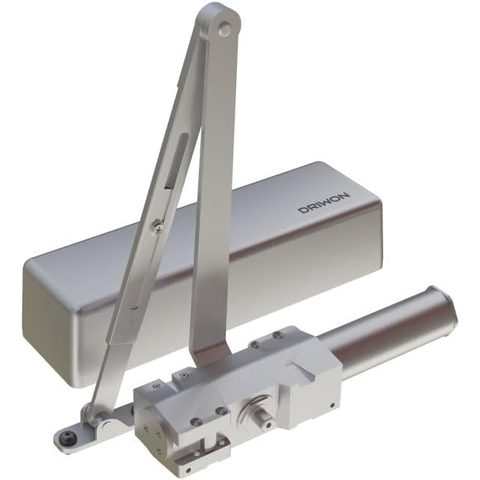
DN-9500 Extra Heavy Duty
- Cast iron body with wrought steel arm
- Doors up to 440 lbs, spring sizes 1 to 6
- ANSI/BHMA Grade 1, UL 3-hour, 2 million cycles
- Silver or matte black
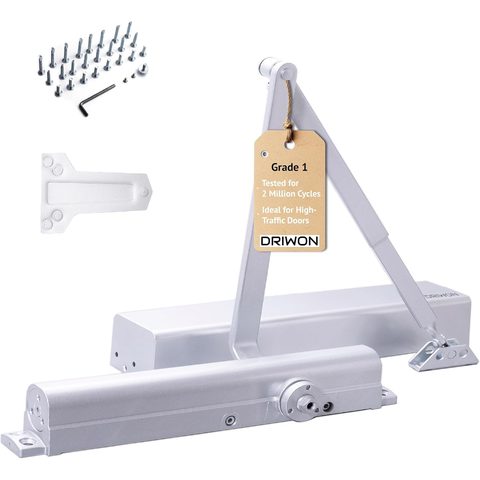
DN-8220 Heavy Duty
- Doors 44 to 440 lbs and 23" to 59" wide
- Adjustable speed, latch, delayed action, backcheck
- ANSI/BHMA Grade 1, UL 3-hour, 2 million cycles
- Parallel arm bracket included, silver or matte black
What a commercial door closer actually does
A commercial door closer is a spring and hydraulic unit mounted at the top of a door. Opening the door compresses a spring. When you let go, the spring pushes the door shut while hydraulic oil, metered through small adjustable valves, controls how fast it travels. That simple job keeps doors latched, keeps heated or cooled air inside, keeps a fire door doing its job and stops a heavy door from slamming into the next person through it.
The difference between a commercial door closer and the $20 pneumatic tube on a storm door is durability and control. A commercial unit is built for hundreds of cycles a day, has separate speed adjustments, and in the better models carries independent test ratings. That is why a heavy duty door closer costs more, and why it tends to be cheaper over the life of the door.
The five questions to ask before you buy
How heavy and how wide is the door? Closers are sized by spring strength, and the width of the door drives the choice more than most people expect. Our door closer size chart gives you the starting point, and the sizing section covers very heavy doors, steel doors and glass storefronts.
How much traffic will it see? A back office door and a school entrance are different jobs. ANSI/BHMA grades separate them, and a Grade 1 door closer is the top tier for busy buildings.
Is the door fire-rated or subject to accessibility rules? A fire-rated door has to self-close and latch, and public doors have ADA limits on opening force and closing time.
Where can the closer mount? Door swing, frame depth and the top rail decide whether you need a regular arm, a parallel arm or a top jamb mount. The install and setup section walks through each one.
What should it look like? Silver suits most aluminum storefronts, but black door closers have become the first choice for dark frames and modern fronts.
What does a good commercial door closer cost?
Expect roughly $25 to $60 for light-duty closers, $60 to $120 for mid-range units and about $130 to $400 for Grade 1 heavy duty models from established brands. Paying more only makes sense if the door needs it. A closet in a quiet office does not need cast iron. A steel exterior door in a Panhandle wind does.
A common mistake is buying on price, watching the closer fail or leak within a couple of years, and paying for labor all over again. If the door is busy, heavy or exposed to weather, buy the heavier closer the first time. If you are replacing a big-name closer, our guide to LCN 4041 alternatives shows what to compare.
Why a hardware store wrote this guide
The Nut House is an independent hardware store on West 10th Street in Borger, Texas. Shops, churches and businesses from Borger, Phillips, Fritch, Stinnett and Sanford rely on us for door hardware. This guide collects what you need to know before you buy. If your situation is not covered, call us at (806) 275-9274.
Commercial door closer FAQ
Frequently asked questions
What is the best commercial door closer?
What is the difference between a commercial and a residential door closer?
How long does a commercial door closer last?
Can I install a commercial door closer myself?
Talk to a real hardware store in Borger
Not sure which closer fits your door? Call us or stop by 519 W 10th St, Borger, TX 79007. Open Monday to Friday, 7:30 AM to 5:30 PM. See our door hardware department or go back to the The Nut House homepage.